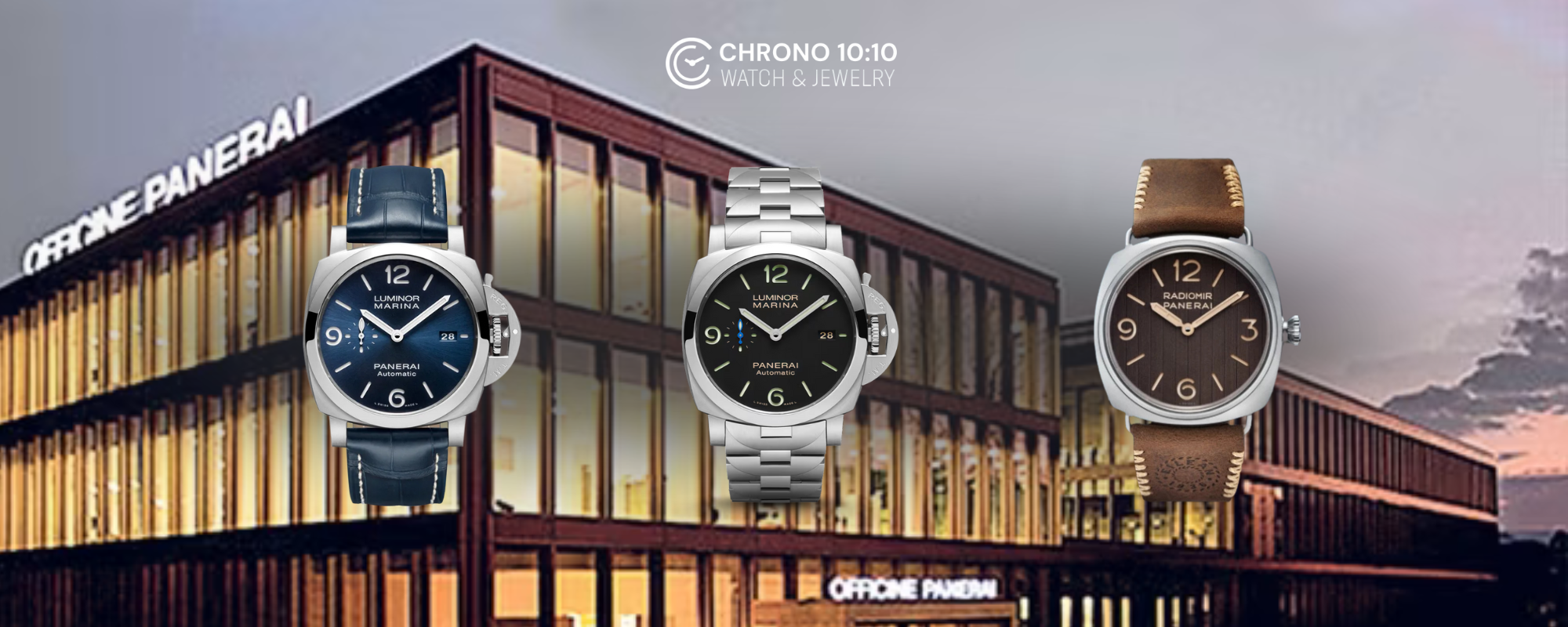
This is the title of an exhibition dedicated to the legendary history of a brand that remained shrouded in secrecy until the fall of 1993, even though Panerai entered the watchmaking world at the beginning of the 20th century. In fact, from the 1910s until 1993, the watches of this now globally renowned brand were worn exclusively by the military. This is confirmed by archival documents attesting to the first orders from the Royal Italian Navy. They open the historical exhibition “Depths of Time,” which pays tribute to the brand’s heritage as a supplier to the Italian Navy.
Protected by Military Secrecy
“The exhibition offers a rare opportunity to look behind the scenes of how Panerai’s distinctive features were born, features that would later evolve into a design recognized worldwide,” said Emmanuel Perrin, CEO of the Panerai Maison, presenting the exposition. The exhibition traces the history of the brand along with its most classified models, the Luminor and Radiomir. For many years, they were protected under the Law on Military Secrecy and were unveiled to the general public only after Panerai was acquired by the Richemont Group in 1997.
The place occupied by Officine Panerai in the watchmaking industry is unique. The brand’s development is linked not only to the craftsmanship of maritime watchmaking but also to innovations that laid the foundation for significant military advancements. For example, Panerai patented Radiomir, a radium-based luminescent powder that adhered perfectly to dials, even underwater. And on the eve of World War II, the company’s developments became strategically important, particularly for the commandos of the First Submarine Group of the Italian Navy.
Military Heritage, Italian Style, and Swiss Precision
This is how the watches that brought fame to Florentine watchmaker Giovanni Panerai can be described today. In 1860, he opened the first watchmaking workshop and the first school for training watchmakers. Over time, the brand’s historical chronicles absorbed the following milestones:
1916 — patent for Radiomir, the brand’s special coating;
1935 — the Royal Italian Navy, together with Panerai, launched a secret program to create landing equipment for underwater special forces;
1940s — development of the model 3646, now known as the Radiomir, in which the brand’s founders added overlapping discs (the sandwich dial) and anodized aluminum on the upper part of the dial, significantly improving readability;
after World War II, Officine Panerai continued to produce strictly classified series of watches for military divers of Mediterranean countries;
1949 — patent for the name Luminor, given to a new tritium-based coating and to diver’s watches with a crown-protecting bridge;
1960s — first use of the Swiss-made Angelus SF240 movement with an 8-day power reserve, which became a defining feature of the brand;
1985 — innovative Millemetri model made of titanium, 47 mm in diameter, featuring a rotating bezel, crown guard, and indices formed from microscopic cylindrical containers filled with luminescent material. Tests showed these watches withstood depths of 1000 meters.
The global crisis of 1992 forced Officine Panerai to enter the public market. At that time, the brand released three collections consisting of 10 entirely new limited-edition models: Luminor, Luminor Marina, and the Mare Nostrum chronograph. These reinterpreted the features of models originally created for the Italian Navy’s special forces. Soon Panerai presented a collection of three similar models and earned international recognition in the world of prestigious sports watches.
Starting in 1997, limited editions featuring rare military-grade calibers, unusual cases made of exotic metals, and complications such as fly-back, foudroyant, split-second chronographs, and a tourbillon based on a Girard Perregaux caliber were released.
The brand’s watches gained even greater popularity thanks to iconic Hollywood actor Sylvester Stallone, who became an admirer of these accessories. Purchasing Panerai pieces by the hundreds for his collection and as gifts, Stallone effectively became a voluntary ambassador of the brand worldwide. Later, such watches appeared on the wrists of Hugh Grant, Arnold Schwarzenegger, Orlando Bloom, and other Hollywood stars.
Features of the Legendary Officine Panerai
Modern versions of Panerai watches have retained most of the characteristics typical of the brand’s secret prototypes:
wide cushion-shaped case;
luminescent hour markers;
calibers with extended power reserve for better water resistance;
high water resistance;
fixed lugs designed for a long strap that can be easily worn over a wetsuit.
And these are far from all the features of the legendary accessories developed by Panerai for naval divers. For example, today’s Panerai Black Seal watches, analogous to the Radiomir Black Seal collection, continue to reflect the brand’s military past, combining advanced materials and design adapted to modern use.
In 2005, the brand premiered its own movement, created in the spirit of the 1950s Angelus caliber, and in 2010 — a trio dedicated to Galileo Galilei. These uniquely complex models — L’Astronomo, Lo Scienziato, and the Jupiterium table clock — feature a functioning celestial sphere with Earth at its center, showing the positions of the Sun, Moon, and Jupiter.
At the SIHH in 2010, Officine Panerai presented its own P.999 caliber and the Luminor Submersible 1950 3 Days Automatic Bronzo model, made of bronze. This material acquires a unique patina over time and is eternally associated with the sea, which played a key role in Panerai’s history.
But let us return to the Florentine exhibition “Depths of Time,” where the brand presents the new Luminor Marina Militare PAM05218 watches. They are a faithful interpretation of the Luminor ref. 5218-202/A model, created specifically for the Italian Navy. Remaining true to its large cases, the watch features a clean and straightforward design:
the steel case is coated with DLC — diamond-like carbon, ensuring durability, wear resistance, and corrosion protection;
the P.6000 caliber has manual winding with a 3-day power reserve, and the balance wheel makes 21,600 vibrations per hour;
the moving balance bridge securely holds the oscillator, improving stability and accuracy;
the dial is a single hollow layer, giving the numerals a three-dimensional appearance;
the contrast between numerals and hands is recreated using caramel Super-LumiNova on the single matte black dial, combined with lighter-toned hands.
Completing the homage to the prototype model is a vintage-style golden-brown strap with a black DLC-coated steel trapezoidal buckle. The watch also comes with a second black rubber strap with an additional buckle.
Thus, all the brand’s innovations originally served functional purposes, and each contributed to shaping the identity of the Panerai Maison. Through the prism of history, the distinctive features of the brand’s unique character demonstrate how a family business, in less than a century, captured public attention with its irresistible charm and became recognizable in the luxury watchmaking industry.