07 October 2026
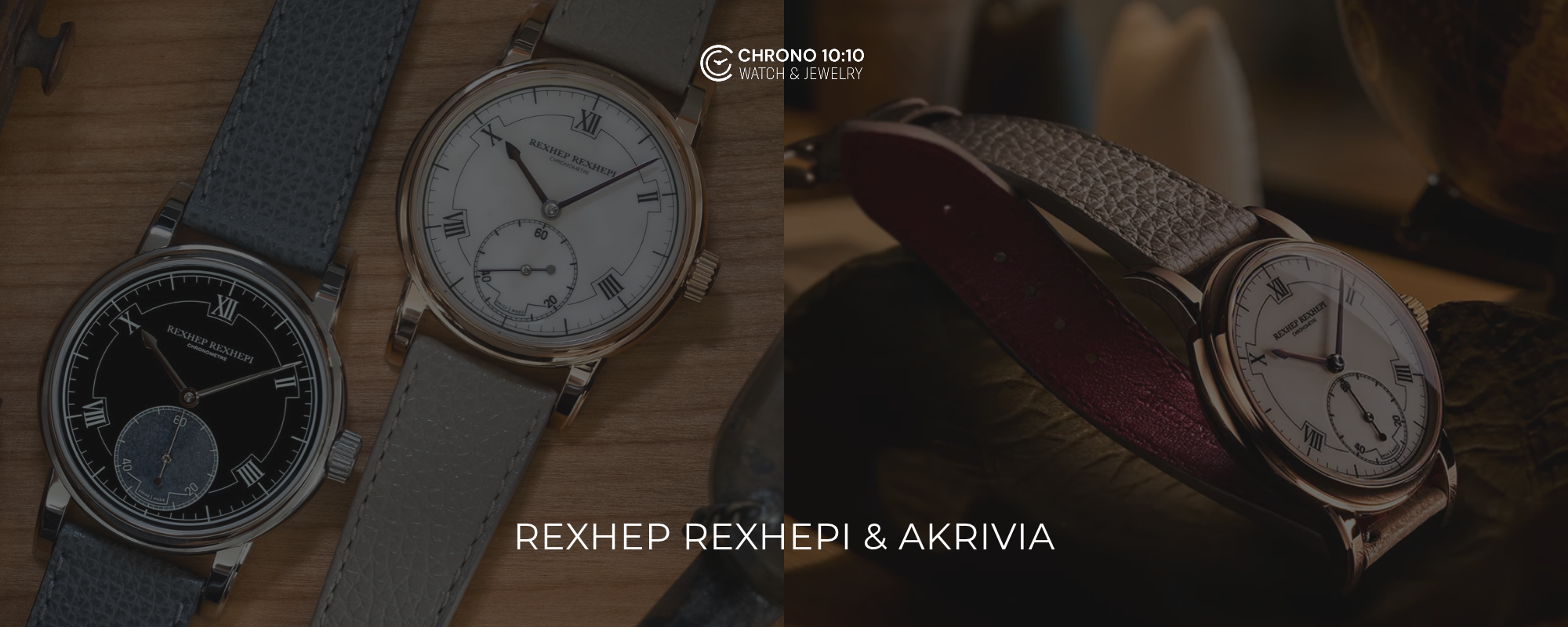
Rexhep Rexhepi and Akrivia: A Story of Craftsmanship and Auction Records


Few would argue with the statement that Rolex is the most recognizable and prestigious brand in the watchmaking world, accounting for more than 30% of the global watch market. The core foundation of the company’s path to leadership over nearly 120 years has remained unchanged:
the invention of ever more advanced movements and technical complications, integrated into the production process with a certain level of secrecy, which has made it possible to achieve manufacturing autonomy;
exceptional reliability in any conditions.
At the same time, Rolex rarely introduces changes to models that have proven themselves perfectly, guided by the principles: “The best is the enemy of the good” and “If it works perfectly, don’t touch it—don’t pursue revolutionary changes for the sake of fashion.”
The uniqueness of Rolex’s approach to watchmaking implies not only sensible conservatism, but also the presentation of new collections, for which the company usually uses the world-famous Watches & Wonders platform. The exhibition typically takes place in Geneva in spring and gathers a large audience of master watchmakers, connoisseurs, and collectors.
At the same time, not all new Rolex releases are unveiled at this largest event of the watch industry. There are exceptions when certain significant models may be presented as part of a sponsorship package at leading global venues in other fields, such as the Academy Awards or the annual Mega-Gala, among others. In addition, the company often employs a strategy of showcasing new models through its famous ambassadors. For example, tennis star Roger Federer went skiing a week before the exhibition opening, “casually” demonstrating a new Rolex model.
Among the new models of the outgoing year 2025, the following stand out:
Oyster Land-Dweller 40 (reference 127334). Experts have called this watch with a new integrated Flat Jubilee bracelet an example of aesthetic and technical boldness. It is presented in the iconic Oyster case with a reimagined construction, crowned by a signature fluted gold bezel. Beneath the honeycomb-patterned dial lies the innovative caliber 7135. The model is produced in three versions, with prices starting at €14,000–15,000 for the steel version and reaching up to €120,000 for models made of platinum and rose gold.
Oyster GMT-Master II (reference 126729VTNR). This model is equipped for the first time with a green Cerachrom ceramic dial. The case features enhanced corrosion resistance. It is made of 18-carat white gold and houses the caliber 3285, which has become the quintessence of the brand’s advanced know-how (simultaneous navigation across two time zones, ultra-precise certified chronometer). Price: approximately $45,000–50,000.
Oyster Perpetual 28 (reference 276200). This model is primarily known for its original aesthetics, with dials in delicate pastel tones—lavender (276200-0008), beige (276200-0007), and pistachio (276200-0006). In addition, within this line the dials feature a matte lacquered finish, which had not previously appeared in the brand’s products. The case ring is cut from a solid block of Oystersteel and topped with a polished domed bezel. Pricing depends on the case diameter and dial color—€6,500–9,500.
In addition, in 2025 Rolex introduced bold design solutions in new dials combining unexpected colors and materials, for example in the Oyster Perpetual Cosmograph Daytona and Sky-Dweller models.
The spread of rumors about the future closure of waiting lists for certain Rolex models is a common practice in the collectible watch market. Despite the lack of official confirmation, market experts believe that in 2026 the brand may discontinue several current references:
Day-Date 36. Models in white gold cases with fluted bezels and diamond-set President bracelets have been discontinued. The historical price range (prior to discontinuation) was $50,000–100,000 (depending on year of production and condition). Current market value (after discontinuation):
yellow gold (base version) — approximately $40,000;
platinum — $60,000–64,000;
configuration with diamond bezel — $88,000–102,000 and above.
If one evaluates the value of a specific model (reference 118238) on the secondary market (Full Set) in 2015 and 2026, it has increased significantly: from approximately $18,000 to $26,500 (+47%).
Floral Motif Datejust 31 (the floral motif line) has been discontinued. Prior to that, the watches were offered at prices ranging from $10,000 to $40,000 (depending on configuration). After discontinuation, their market value increased and now stands at $7,000–54,000.
Sea-Dweller, introduced as an anniversary model, may be discontinued at the end of the celebratory campaign. Its price ranges from €11,500 to €15,000. Since the production was likely limited, this price on the secondary market may remain stable.
GMT-Master Pepsi. For more than 70 years, the company has been producing watches with the traditional red-and-blue bezel. Thanks to regular model updates, they continue to enjoy strong demand among Rolex enthusiasts. Due to limited availability, waiting lists are growing longer, leading to waiting times of several years. Depending on the condition and reference, prices on the secondary market over the past 10 years have changed as follows:
reference 1675 — approximately $6,000–8,000 in 2015 and about $15,000 today;
16700 — growth from approximately $4,000–5,000 to $11,600;
116719BLRO — value increased from approximately $38,000 to $52,000.
Rolex Milgauss. The model was discontinued in 2023; however, there are rumors of its possible return for the brand’s 70th anniversary. The main feature of this watch, attracting collectors and experts, is its unique-for-its-time ability to withstand magnetic fields of up to 1,000 gauss.
Price dynamics on the secondary market are around $11,000, which is noticeably higher than the $9,150–9,300 price at which the watch was offered before production ceased.
At the Watches & Wonders 2025 Geneva Salon, it was also announced that several models would be discontinued. The most significant event was the discontinuation of the entire Oyster Perpetual Celebration Dial model line.
At the same time, such anticipated changes as the discontinuation of the GMT-Master II (Pepsi and Sprite)—rumors of which circulated in 2024—were not confirmed. Moreover, the palette of pastel-toned Oyster Perpetual dials was even expanded with new materials. For example, the GMT-Master II in Everose gold received a dial made of tiger iron.
Thus, a decision to completely discontinue a model or to transfer it into the category of exclusively limited or individual releases immediately turns these watches into cult rarities. This is instantly reflected in the market: prices on the secondary market demonstrate a sharp upward dynamic.

15 years on the market

Own service center

2 years of official warranty

Verified authenticity