07 October 2026
Rexhep Rexhepi and Akrivia: A Story of Craftsmanship and Auction Records

Premium Swiss watches are typically fitted with sapphire crystal, which should fit perfectly against the watch case. Scratching sapphire crystal is virtually impossible, as it has a hardness of 9 on the Mohs scale, second only to diamond (10 out of 10). However, it is important to note that if the crystal features an anti-reflective coating, that coating is more susceptible to scratches than the sapphire itself. At the same time, sapphire's exceptional hardness comes with one drawback—it can crack if subjected to a strong impact.
Many watches feature a magnifying lens above the date window, as seen on the iconic Rolex models equipped with the Cyclops lens, which magnifies the date by 2.5 times. Determining whether a crystal is sapphire without specialized equipment is quite difficult. A common belief suggests that water droplets gather into a single bead, similar to mercury, rather than spreading across the surface. In reality, however, the behavior of water droplets depends primarily on:
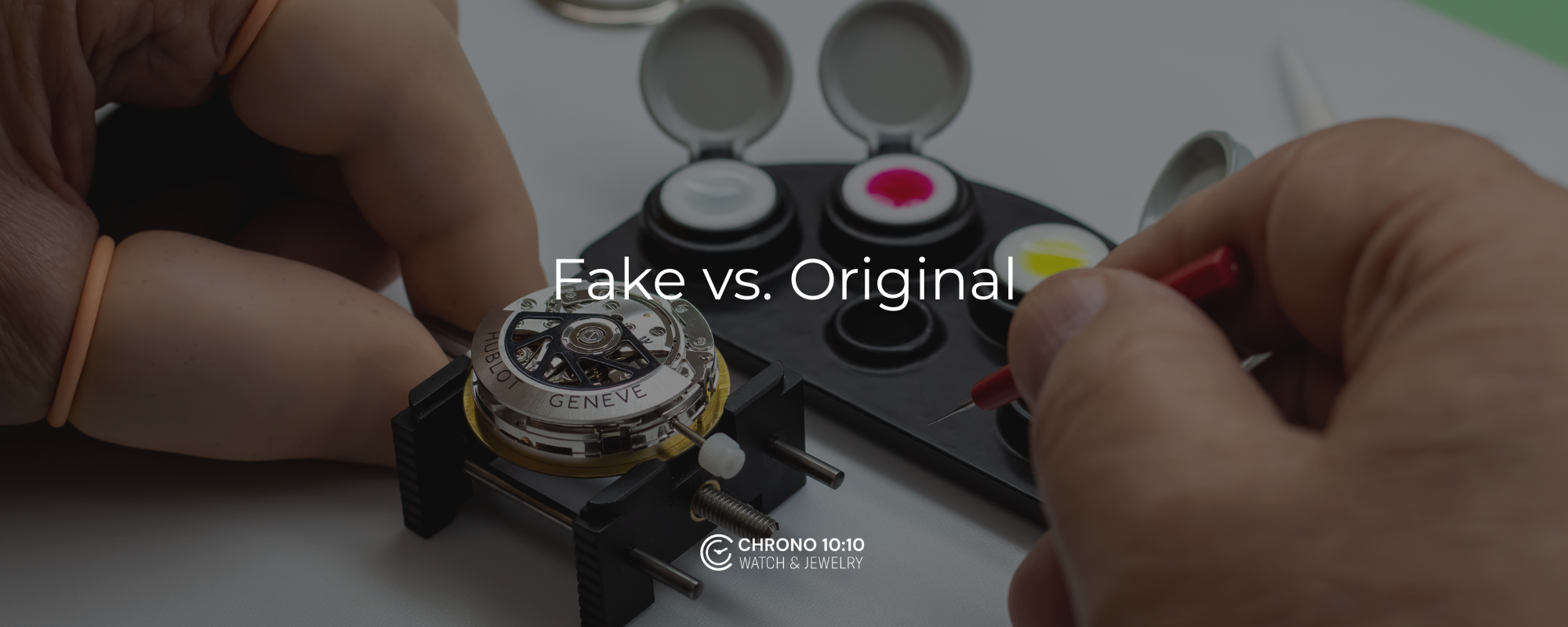
The most reliable way to distinguish a counterfeit is by using specialized instruments available to professional watchmakers. These devices measure:
Experts often describe the movement of an authentic Swiss watch as the "Achilles' heel" of counterfeit manufacturers. True quality is revealed not only by flawless aesthetics but, above all, by the precision of the caliber and every component of the movement. For example, many modern Rolex calibers, including the 3235 and 3230, operate at 28,800 vibrations per hour, allowing the seconds hand to glide smoothly across the dial. If the seconds hand ticks noticeably rather than sweeping smoothly, it is advisable to be cautious, as the watch may contain a simple quartz movement or a low-quality mechanical caliber.
Pushers, complications, the self-winding system, and the winding crown may appear authentic while failing to perform their intended functions. Counterfeit watches may also feature "mystery" buttons—for example, chronograph pushers without any chronograph subdials on the dial. Unlike these decorative imitations, genuine branded movements, bezels, and every functional component consistently demonstrate exceptional quality, even in the smallest details.
When inspecting the winding crown, pay close attention to its operation and the precision of each setting position. The crown should engage positively without any looseness or play. On counterfeit watches, it may wobble, require excessive force to turn, or move inconsistently with noticeable jerks.
The winding crown on a genuine watch is manufactured to extremely high standards. It features precisely machined teeth and evenly finished grooves, while some brands also engrave their logo or emblem onto the crown. All pushers should operate smoothly and require only minimal pressure.
The date function is easy to test—simply set any date and verify that it changes correctly. Chronograph pushers should be checked using the proper sequence. Normally, the winding crown sits firmly against the case. Pressing the upper pusher starts the chronograph seconds hand, pressing it again stops the timing function, and pressing the lower pusher resets the chronograph to zero.
When evaluating a bezel, several key details can help determine whether it is genuine. This rotating ring immediately reveals the quality of the materials, engravings, and markings, while also making it easy to assess any play and the overall functionality.
Most premium bezels are made from ceramic, which on authentic watches has a perfectly smooth surface, rich color, and sharply defined edges. A bezel may rotate in one or both directions, but in either case it should move with firm, even resistance and distinct clicks. On diving watches, the bezel is typically unidirectional, rotating only counterclockwise. If it rotates freely in both directions or feels excessively loose, this may indicate a counterfeit.
In addition, luxury watches feature bezel markers filled with high-quality luminous material that glows brightly and evenly. The transition between the bezel, the case, and the crystal should be perfectly seamless, with no sharp edges or imperfections that could catch on clothing.
A watch's serial number is certainly useful, but many people overestimate its importance when identifying a counterfeit. By itself, a serial number does not guarantee authenticity and can be copied. A much more reliable indicator is whether the serial number on the case matches the one in the documentation and warranty card. The absence of a warranty card is a strong reason to question the watch's authenticity.
How can you verify a watch's authenticity using its documentation? In fact, having the original documents and branded packaging is extremely important. Equally important is checking the seller, who should be an authorized dealer or a company with an excellent reputation.
The watch reference number is also essential. Using it, you can find detailed information about the watch on specialized websites. By entering the serial number, you can identify the model, production date, movement, and other specifications. Many service databases also provide this information through a QR code.
First and foremost, a genuine Swiss watch cannot be sold below a certain price level. While personal discounts are certainly possible, brands such as Patek Philippe and Audemars Piguet simply cannot be purchased for less than €15,000. This is a fundamental rule, just as genuine Swiss watches should only be purchased from trusted sellers. If you have even the slightest doubt, it is best to consult a watch industry expert—this can help you avoid costly mistakes.
The table below highlights just some of the key criteria to consider.
| Parameters | Genuine Watch | Counterfeit |
|---|---|---|
| Case and Assembly | Perfect fit of all components, precise finishing and polishing | Loose parts, rough burrs, and sharp edges |
| Engravings and Markings | Straight, sharp, free of errors or misalignment | Crooked, uneven, blurred |
| Crown and Pushers | Smooth operation with precise positioning | May wobble, rattle, or rotate unevenly |
| Functionality | Fully matches the reference specifications | Functions are decorative or operate incorrectly |
The conclusion is clear: if you are planning to purchase a genuine premium Swiss watch, take the time to study all available information. Better yet, consult the experts at Chrono 10:10—they can help you save your money, time, and peace of mind.
How can I tell if a watch is genuine?
Check the seller, the reference number, the documentation, the consistency of all markings, the quality of the assembly, and the operation of every function. Authenticity can never be determined by a single characteristic alone.
Can you identify a fake Rolex by its Cyclops magnifying lens?
Yes. This is one of the most reliable indicators. On a genuine Rolex, the Cyclops lens magnifies the date exactly 2.5 times without distortion or glare. On counterfeit watches, the magnification is usually weaker, the image appears blurry, or the date becomes distorted around the edges. In addition, genuine Rolex crystals are typically fitted with anti-reflective coating, resulting in little or no glare.
Which is more important to inspect: the movement or the appearance?
Both should be inspected. However, it is best to begin with the external appearance by checking the quality of the engravings, luminous markers, the smooth sweep of the seconds hand, and the gaps between the case and bracelet. If the external details raise concerns, there is little point in examining the movement further. For complete confidence, consult a qualified watch specialist.
Does a high price always mean the watch is genuine?
No. High-quality counterfeits (often called "super clones") are frequently sold at prices close to genuine watches to create the illusion of authenticity. Fraudsters may even use original boxes, documents, and receipts. Therefore, a high price alone is never proof of authenticity. When in doubt, have the watch examined by an expert.

15 years on the market

Own service center

2 years of official warranty

Verified authenticity