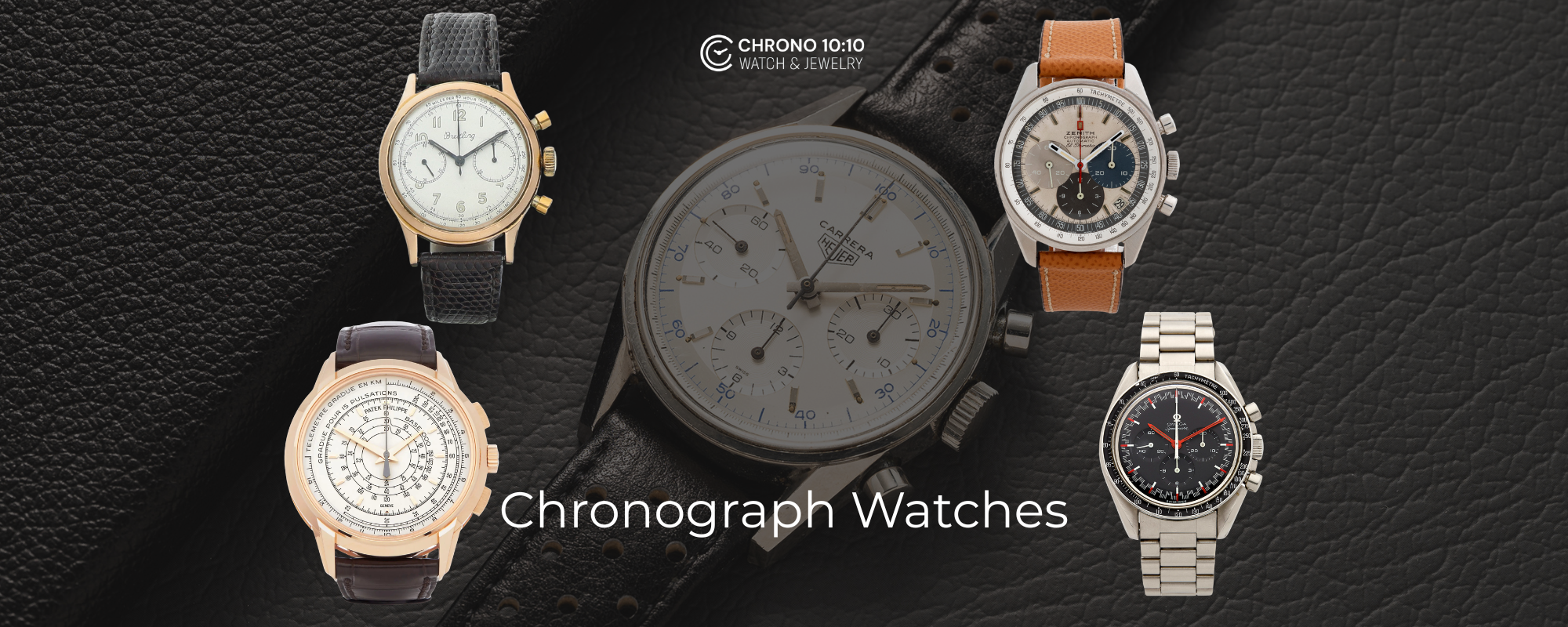
Whether you are choosing your first watch or looking to expand your collection, a chronograph watch is always an excellent choice. Why? First and foremost, it is a measuring instrument rather than simply a beautiful decorative piece. All these scales — tachymeter, pulsometer, telemeter, decimal scale — were invented as essential technical complications required by the military, pilots, racing drivers, yachtsmen, engineers, doctors, and others. And it is not just about subdials and multiple pushers, but also additional scales. They are worth exploring in greater detail to properly and effectively use all their useful functions and to avoid confusing a chronograph with a chronometer.
Remember: a chronograph and a chronometer are completely different concepts! A chronograph is a complication (a stopwatch), while a chronometer indicates the highest level of timekeeping accuracy, confirmed by certification. A watch can be a chronograph, a chronometer, or combine both qualities (for example, Rolex Daytona or Zenith El Primero). To clarify: a chronometer is a watch that has received the corresponding Bulletin du marche certificate after individually undergoing special accuracy tests. This certification is officially carried out by the Swiss Official Chronometer Testing Institute COSC (Controle Officiel Suisse des Chronometres). So, what exactly is a chronograph?
Measuring Time
This is the primary function behind the term “chronograph”, which can be divided into starting, stopping, and recording a result. The term first became known among researchers of astronomical objects, for whom French watchmaker Louis Moinet created an instrument in 1816 that became the precursor to the modern chronograph. Later, a similar device was needed by King Louis XVIII of France, a passionate enthusiast of horse racing.
Chronographs appeared in wristwatches at the beginning of the 20th century. The evolution of fashion during this period coincided with military necessity, which led luxury watchmakers such as Patek Philippe and Audemars Piguet to incorporate chronographs into gold wristwatch cases. Between 1923 and 1939, Patek Philippe produced 11 wristwatches with split-seconds chronographs and dials signed by Cartier. One of them was worn by Amelia Earhart and was sold at auction in 2024 for € 1 736 000.
In 1915, Swiss watchmaker Gaston Breitling (Breitling) created the first wrist chronograph with a separate stopwatch pusher positioned at 2 o’clock. In 1934, his son Willy Breitling patented a system with two separate pushers — one for start/stop and another for reset.
Modern chronographs are classified into the following types:
- classic — starts and stops elapsed-time measurement;
- split — allows the timing of two events simultaneously;
- fly-back — resets the chronograph and immediately starts a new measurement with a single press of the pusher.
Chronograph watches are popular among people who lead active lifestyles and know how to manage their time effectively, making practical use of chronograph scales, auxiliary subdials, and pushers.
Tachymeter — A Classic Among Scales
At first glance, the scale that turns a chronograph into a speedometer and is known as a tachymeter may seem complicated. In reality, it is quite simple: the central seconds hand indicates the average speed on the tachymeter scale. To obtain the result, you should:
- Mark the start of the movement by pressing the “start” button.
- Travel exactly 1 km and stop the chronograph.
- The mark where the central seconds hand stops indicates the speed.
The tachymeter scale is usually located on the bezel or around the edge of the dial. The speed can be determined instantly, with no additional calculations required. For example, if a car travels 1 km in 30 seconds and the hand stops at the 120 mark, the speed is 120 km/h.
The visual appearance of the scale depends on the brand and the chronograph model. The classic configuration places the scale on a fixed bezel, as seen on well-known models such as the Rolex Daytona and Omega Speedmaster. This arrangement prevents the dial from appearing overly cluttered and preserves its legibility. On vintage watches, the scales are often printed directly on the dial, making it somewhat busier. There are also spiral tachymeter scales, where aesthetics are combined with expanded technical capabilities: a wider measurement range and longer timing intervals exceeding 1 minute.
What Else Can Be Measured with a Tachymeter
A tachymeter can be used to measure the frequency of any repetitive action, such as the productivity of a machine over a given period, ultimately determining the volume of production. For example, if a component takes 45 seconds to process on a machine and the tachymeter hand points to 80, the operation’s productivity is 80 components per hour. The same method can be used to measure various quantities: the number of printed pages, completed packages, assembled components, and more.
Areas of application:
- Tourism and orienteering, where successful completion of a route depends on the speed of movement.
- Sports involving speed over a distance: running, race walking, swimming, triathlon, cycling, and other races.
- Logistics, where delivery speed can be calculated based on the distance travelled.
Thus, a tachymeter measures the number of events or operations performed per hour. Popular among athletes, explorers, businesspeople, military personnel, and pilots, this scale has become an essential feature of premium watches from renowned brands and part of their DNA. For example, the tachymeter of the Rolex Cosmograph Daytona is closely associated with motorsport; on the TAG Heuer Carrera and Zenith Chronomaster, it is an essential element of classic sports chronographs; while on the Omega Speedmaster Professional, the tachymeter bezel forms part of the legendary Moonwatch heritage.
Pulsometer — A Chronograph for Doctors
The chronograph was a revolutionary invention from the outset, along with its various additional functions and scales, including the pulsometer, which appeared in the 1920s for quick pulse measurement. It was used by medical professionals in everyday practice and measured heart rate in the simplest possible way, without additional calculations — the scale does all the work. To use it, the chronograph should be started the moment the pulse is detected. The step-by-step procedure for measuring heart rate with a pulsometer is as follows:
- Press “start” and begin counting pulse beats — 15 or 30, as indicated on the scale, for example, Gradué pour 30 pulsations.
- Stop the chronograph — the hand indicates the heart rate in beats per minute. For example, if the scale is calibrated for 30 beats, 20 seconds have elapsed, and the hand points to 90, this means a heart rate of 90 beats per minute.
If it is important to determine the heart rate as quickly as possible due to an emergency, a 15-beat scale can be used. However, the 30-beat scale is more accurate, which is particularly important for doctors, as watches with pulsometer scales remain useful medical instruments. This is why luxury watch models featuring such scales continue to attract interest, including the Omega Speedmaster CK2998 Pulsometer (a limited edition released in 2018) and Patek Philippe models such as the iconic Ref. 130 from the 1930s–1940s, Ref. 5170J (2010), and others.
Telemeter — Measuring Distance From and To
A chronograph that measures the distance to an object using the difference between the speeds of light and sound (~340 m/s) may initially seem rather complicated. In reality, the scale that turns a chronograph into a rangefinder was invented for military artillerymen, who used it at the beginning of the 20th century to measure the distance to exploding shells they had fired.
Today, in addition to its military purpose, such a scale can be used to determine the distance to a thunderstorm. The chronograph is started when lightning flashes and stopped when the sound of thunder begins. The hand then indicates the distance to the approaching storm. For example, if 6 seconds pass between the flash of lightning and the thunder, the storm is 2 km away.
Swiss watches often indicate distance in kilometres, while British and American watches use miles. In some vintage models, manufacturers combined a tachymeter and telemeter on the same dial. Examples include the TAG Heuer Carrera Calibre 18 Telemeter, Omega Speedmaster Professional Telemeter (Ref. ST 145.012, ST 145.022, ST 3570.50 / 3572.50), Patek Philippe Ref. 5975 / Vintage Ref. 130, and Breitling Premier B01 Chronograph.
Decimal Scale — A Valuable Tool for Engineering and Science
The rare decimal scale simplifies calculations in industrial engineering, scientific research, and technology development. It differs from conventional scales in that it measures time in tenths and hundredths of a minute. For example, 18 seconds equals 0.30 minutes, 30 seconds equals 0.50 minutes, 45 seconds equals 0.75 minutes, and so on.
This is the fundamental principle behind the decimal scale: those who own a watch equipped with this scale do not need to convert seconds into decimal fractions of a minute, which is particularly convenient when tracking working time. In practice, on a conventional watch, a process lasting 18 seconds would need to be converted. On a decimal scale, it can be read immediately as 0.30 minutes. If the same action is repeated 100 times, the total time can easily be calculated.
Today, this type of scale is most commonly found on vintage chronographs. Well-known examples include:
- Heuer Carrera 2447D (the letter “D” stands for Decimal);
- Patek Philippe: vintage models (Ref. 130 and Ref. 1463) and Ref. 5975;
- Breitling Premier Decimal & Top Time (Ref. 777, 787, 788);
- Zenith El Primero Vintage Decimal Code Ref. A386.
Chronograph Scales — History and Technical Excellence
Although today’s digital world offers smartwatches and smartphones that can perform many tasks much faster than chronograph scales, this does not diminish the uniqueness of the latter. Moreover, they are always stylish, and their design seems to say: “I am a true connoisseur of watches with history and soul.”
So, if you want to own a watch with character and useful functions that will impress you with the precision of various measurements and its distinctive aesthetics, contact Chrono 10:10 — our specialists will help you select a model that suits your tastes and needs. We love watches and know that every scale and complication has its own history, just like every premium timepiece. At the Chrono 10:10 boutique, we will help you find the perfect chronograph with a guarantee of authenticity.